Annual Reports
Charter Communications, Inc.'s annual reports contain management's most considered account of the business. These are the sections, passages and visual pages worth opening in the originals preserved in Sources.
Charter Communications, Inc. — FY2025 Annual Report (Form 10-K) — FY2025
Management's fullest account of the Spectrum broadband business on the eve of its transformative Cox and Liberty Broadband deals. · Open the full document →
Item 1. Business — p. 7 · Read the full section →
Management's own framing of what the company is, what it sells, and the convergence strategy behind it.
The business in one paragraph: a Spectrum broadband operator serving 58 million homes across 41 states, and its convergence strategy.
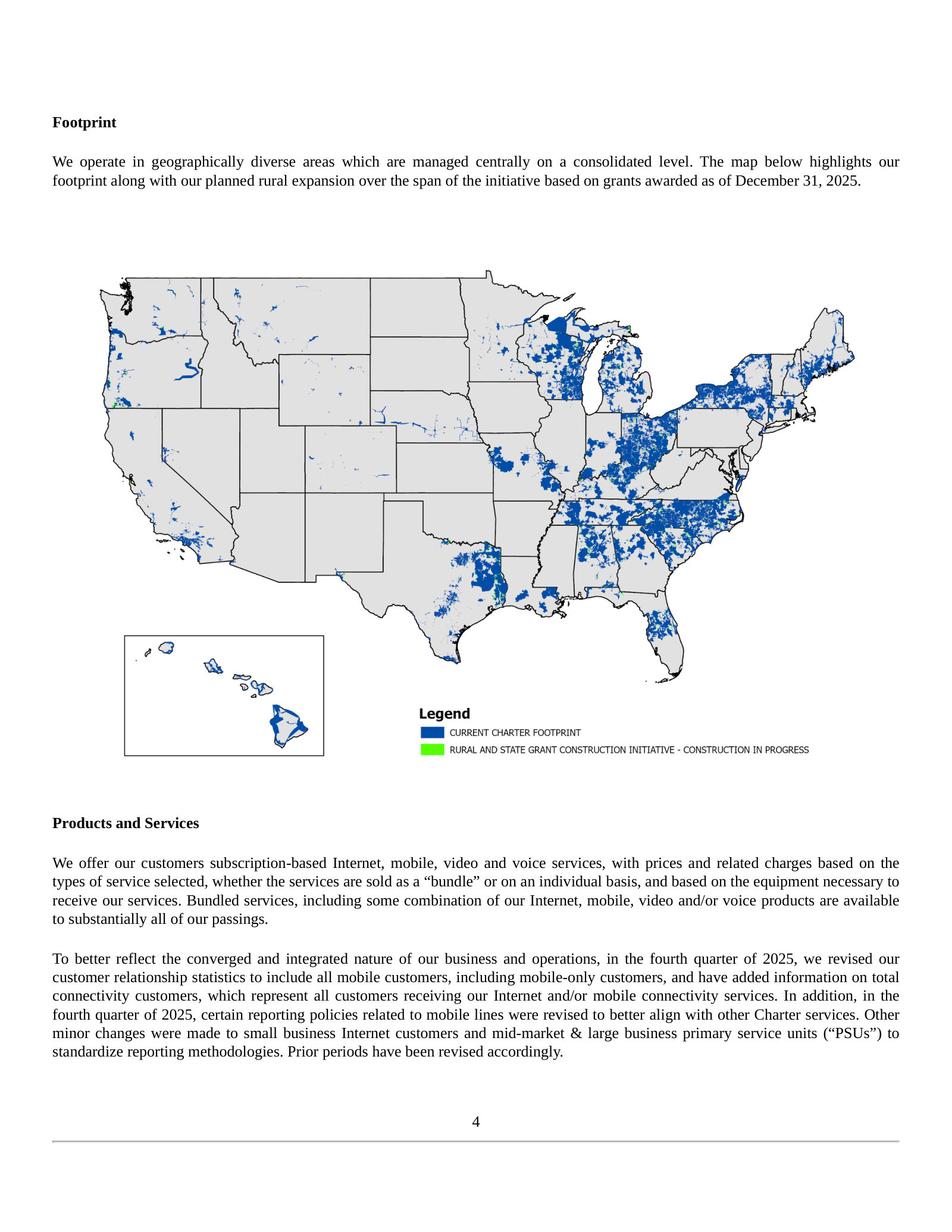
We are a leading broadband connectivity company with services available to 58 million homes and small to large businesses across 41 states through our Spectrum brand. Founded in 1993, we have evolved from providing cable TV to streaming, and from high-speed Internet to a converged broadband, WiFi and mobile experience. […] Our strategy is focused on utilizing our fiber-powered network to deliver high-quality, competitively priced products, with outstanding service, allowing us to increase both the number of customers we serve over our network and the number of products we sell to each customer. This combination also reduces the number of service transactions we perform per relationship, yielding higher customer satisfaction and lower customer churn, which results in lower costs to acquire and serve customers and drives greater profitability.
p. 7 · Read in context →
Products and Services — Residential Connectivity — p. 15 · Read the full section →
Shows how the money is actually made — the Internet-plus-mobile bundle and the network partnerships behind Spectrum Mobile.
How the bundle works: Spectrum Mobile rides Verizon's network, with a 2025 T-Mobile deal added for business customers.
Our Spectrum Mobile service is offered to customers subscribing to our Internet service and uses the customers’ private WiFi, our Spectrum Mobile network (comprised of 49 million out-of-home WiFi access points across our footprint combined with out-of-home WiFi access points from other networks with which we partner) as well as leveraging the cellular network of Verizon Communications Inc. ("Verizon"). We leverage the Verizon cellular network to provide nationwide coverage including unlimited calls, text and data using Verizon’s fourth generation and fifth generation (“5G”) service including their latest 5G technology. […] In addition, in July 2025, we entered into a multi-year agreement with T-Mobile US, Inc. (“T-Mobile”) to use their network to deliver mobile services to Spectrum Business customers which is set to launch in 2026.
p. 15 · Read in context →
Competition — p. 27 · Read the full section →
The central investment question for cable: how much of the footprint fiber and fixed-wireless rivals can take.
Internet competition: national telco fiber overbuilds roughly 27% and 16% of the footprint, alongside fixed-wireless and satellite.
Our residential Internet service faces competition across our footprint from fiber-to-the-home ("FTTH"), fixed wireless broadband, Internet delivered via satellite and DSL services. […] AT&T Inc. ("AT&T") and Verizon are our primary FTTH competitors. We face terrestrial broadband Internet (defined by the Federal Communications Commission (“FCC”) as at least 100 Mbps) competition from AT&T and Verizon in approximately 27% and 16% of our operating footprint, respectively.
p. 27 · Read in context →
Liberty Broadband Combination and Cox Transactions — p. 31 · Read the full section →
The two deals that reshape the company — scale, ownership, and leverage all change here.
The Cox Transactions: Charter to combine with Cox Communications' residential cable and commercial fiber businesses.
On May 16, 2025, Charter, Charter Holdings, and Cox Enterprises, Inc. (“Cox Enterprises”) entered into a Transaction Agreement (the “Transaction Agreement”) pursuant to which (i) Cox Enterprises will sell and transfer to Charter 100% of the equity interests of certain subsidiaries of Cox Communications, Inc. (“Cox Communications”) that conduct Cox Communications’ commercial fiber and managed IT and cloud services businesses (the “Equity Sale”), (ii) Cox Enterprises will contribute the equity interests of Cox Communications and certain other assets (other than certain excluded assets) primarily related to Cox Communications’ residential cable business to Charter Holdings (the “Contribution”), and (iii) Cox Enterprises will pay $1.00 to Charter (collectively, the “Cox Transactions”).
p. 31 · Read in context →
Item 1A. Risk Factors — p. 44 · Read the full section →
The two company-specific risks that could genuinely bite: a heavy, growing debt load and a concentrated, governance-rich shareholder base.
Leverage is the defining risk: about $94.6 billion of principal at 4.15x EBITDA, with more debt to fund and assume in the Cox deal.
We have a significant amount of debt, with total principal amount of approximately $94.6 billion and a leverage ratio of 4.15 times Adjusted EBITDA as of December 31, 2025. […] As part of the Cox Transactions, Charter will fund the $4.0 billion of cash consideration using debt and will assume Cox Communications' approximately $12.6 billion of net debt and finance leases.
p. 52 · Read in context →
Item 7. MD&A — Overview and Results of Operations — p. 80 · Read the full section →
Where management explains what actually drove the year — mobile growth against Internet and video pressure.
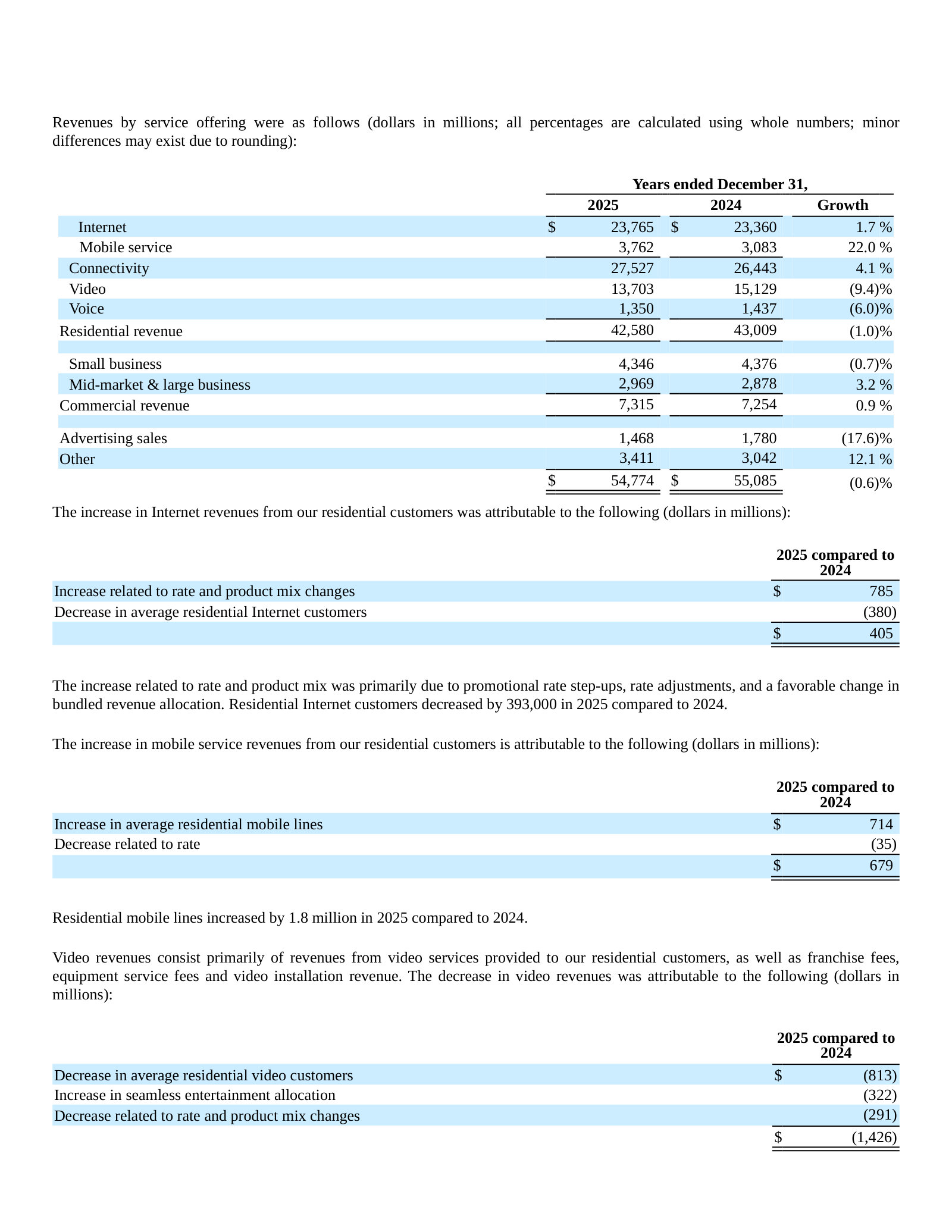
What drove 2025: 1.9 million mobile lines added while Internet and video losses eased on lower churn.
During the year ended December 31, 2025, we added 1.9 million mobile lines while Internet and video losses improved as compared to the prior year period. Sales were challenged by the competitive environment but were offset by lower customer churn.
p. 80 · Read in context →
Critical Accounting Policies — Valuation and Impairment of Franchises and Goodwill — p. 84 · Read the full section →
The accounting choice that defines the balance sheet: indefinite-lived franchise rights that dwarf everything else.
Balance-sheet oddity: $67.5 billion of indefinite-lived franchise rights are 44% of assets, tested for impairment but never amortized.
The carrying value of franchise intangibles as of both December 31, 2025 and 2024 was approximately $67.5 billion (representing 44% and 45% of total assets, respectively), and the carrying value of goodwill as of both December 31, 2025 and 2024 was approximately $29.7 billion (representing 19% and 20% of total assets, respectively). […] We have concluded that all of our franchises qualify for indefinite life treatment given that there are no legal, regulatory, contractual, competitive, economic or other factors which limit the period over which these rights will contribute to our cash flows.
p. 84 · Read in context →
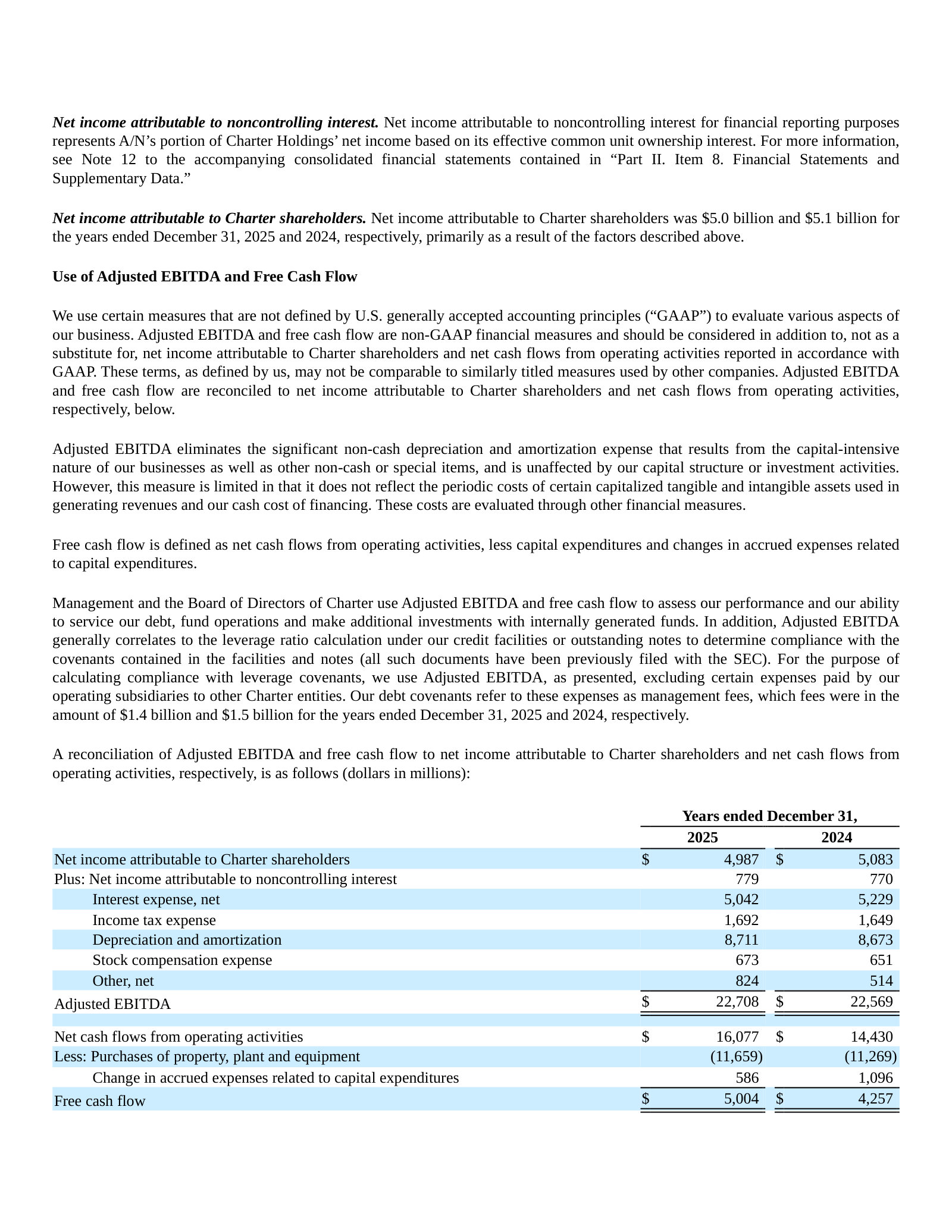
Use of Adjusted EBITDA and Free Cash Flow — p. 94 · Read the full section →
The non-GAAP measures Charter is run and lent against — read them before any headline EPS figure.
More annual reports
Charter Communications, Inc. — FY2024 Annual Report (Form 10-K) — FY2024 · 183 pages · Prior-year 10-K; the first to detail the November 2024 Liberty Broadband merger agreement, before the Cox deal was signed. · Open →
Charter Communications, Inc. — FY2023 Annual Report (Form 10-K) — FY2023 · 174 pages · Pre-deal baseline: mobile still scaling and the network-evolution plan freshly laid out. · Open →
Charter Communications, Inc. — FY2022 Annual Report (Form 10-K) — FY2022 · 165 pages · Captures the shift to converged connectivity and the early Spectrum Mobile ramp. · Open →
Charter Communications, Inc. — FY2021 Annual Report (Form 10-K) — FY2021 · 181 pages · Earlier edition, useful for how the business was framed before mobile and convergence took center stage. · Open →